Unsupervised on a Schwin: Answering the Newsletter With the Most Passive-Aggressive Article Ever Printed
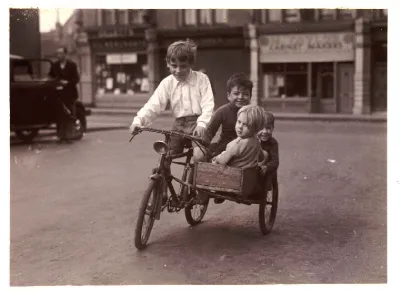
Photo: National Media Museum, No restrictions, via Wikimedia Commons
The Accusation, Verbatim
Under a section titled Community Watchful Eyes, sandwiched between a complaint about trash cans being visible from the street and a reminder that garage doors should close 'promptly,' our neighborhood newsletter included this sentence: 'Residents have noticed unsupervised children on bicycles in the cul-de-sac, which some may find negligent adjacent.'
Negligent adjacent. Not negligent. Just close enough to negligent that you can smell it. It's the neighborhood-watch equivalent of calling someone 'problematic curious.'
Those children are mine. They are 8 and 11. They have been riding bikes around our cul-de-sac since they were 6 and 9, respectively, wearing helmets, within a quarter mile of home, with a working knowledge of what a driveway looks like. And according to Carol — I don't know that it's Carol, but we all know it's Carol — this is a red flag worth printing and distributing to 240 households.
What 'Negligent Adjacent' Actually Describes
Here's what was happening during these alleged incidents of unsupervision: my children were riding in circles. That's it. That's the whole activity. They were not base jumping. They were not accepting candy from strangers. They were doing laps on a dead-end street where the biggest hazard is Mrs. Petrelli's退休 Buick backing out at a blistering 4 miles per hour.
Somewhere in the last two decades, we decided that a child out of arm's reach is a child in danger. The research doesn't back this up — violent crime against children is lower than it was in the 1970s and '80s, when an entire generation was told to be home by the streetlights. What has increased is our ambient anxiety and our willingness to outsource it to newsletters.
The Porch Conversation Script (For When Carol Comes Knocking)
You will eventually have this conversation. Here's how to survive it without becoming the neighborhood villain.
If they say: 'I just saw the kids out there alone and got worried.' You say: 'Thank you for caring about them. They're riding loops and they know to come home at five. If you ever see something actually dangerous, please knock on my door immediately.'
This works because it's warm, it's specific, and it gives them a job. Nosy neighbors are just worried people without a task. Hand them a task.
If they say: 'Something could happen to them.' You say: 'Something could happen to any of us. I've decided the risk of bike laps is lower than the risk of raising kids who can't cross a street at 16.'
If they say: 'I'm going to mention it at the next meeting.' You say: 'Please do. I'll bring the helmet safety stats.'
When You Should Actually Worry
Let's be honest with ourselves, because credibility matters. I do intervene when:
- My kid is on a road with real traffic and no shoulder
- The helmet stays home more than once
- A younger kid on the block is being pressured into something they're not ready for
- Actual injury occurs and nobody comes to get me (this has happened once; it involved a skinned elbow and a very dramatic limp)
Notice that 'a neighbor could see them' is not on the list.
A Modest Proposal for the Next Issue
If the newsletter wants to flag genuine safety concerns, I have some: the four-way stop that nobody treats as a four-way stop. The guy who runs his leaf blower at 7 a.m. on Sundays. The pool gate that latches wrong. These are things that could hurt children. Bike laps cannot, statistically speaking, and the evidence that unstructured play builds competent, confident, less-anxious kids is about as strong as research gets.
I've submitted a rebuttal to the newsletter editor. It has not been published. Apparently my piece was deemed 'concerning adjacent.'
Warmest regards, The Negligent Adjacent Family of #47